From the Desk
Employed, Housed and Paid in Porridge: The Christmas Gnome's Terms of Service, Graded
Twenty-three filings on the Christmas gnome, and the best-documented thing on the farm is his porridge.
By Casimir Vane The Registers · Filed Under Protest 2026-11-27
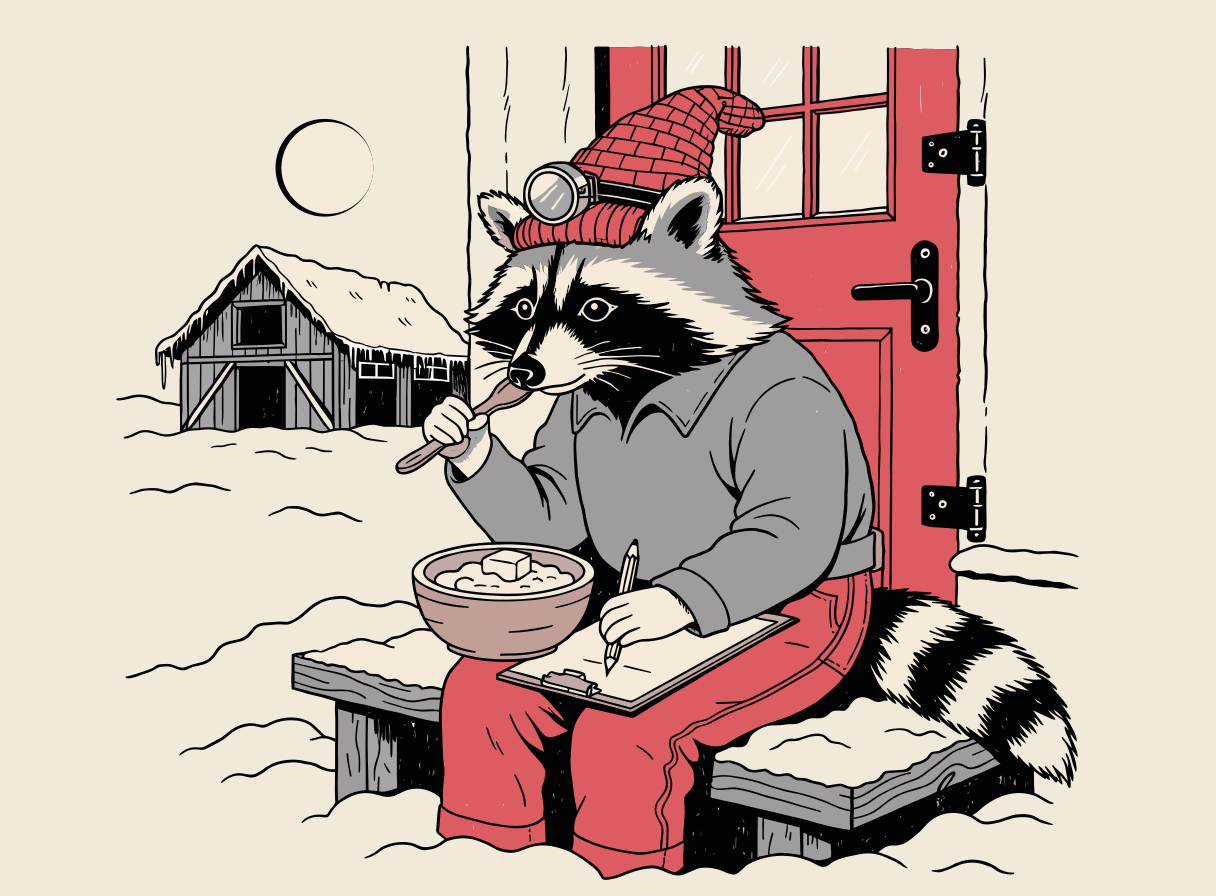
I filed nine registers this autumn on creatures a household is afraid of, and more often than not the rule everybody obeyed had been made up, more recently than anybody thought, by somebody with a camera. I had expected December to be a rest.
It is not, because the creature of the season is staff. Almost the whole of the folk record about the Christmas gnome is a set of terms and conditions: what he does, what he is owed, and what happens when the household pays him short or pays him too much. When I went to the Danish encyclopedia for a summary of the tradition, it used the word for wages. One nisse to a farm, a room in the loft over the stable, and a bowl of porridge with butter every Saturday evening and at the holidays. I have read my own contract twice this week, at night, which is when I read everything, and it has none of these.
For once the terms are as old as the documents. The porridge is in the first Danish collection, the job description is in English by 1850, and a Swedish poem of 1881 sends him round the farm at midnight trying every lock. What was invented later is the part of him the shops sell in December.
Two lineages share the spine, and I have kept them apart. The tomte and the nisse are Scandinavian farm staff. The garden gnome is a German ornament that arrived in an English garden in 1847 and was called a gnome on arrival, and the word itself belonged first to neither of them but to an alchemist’s spirit of earth. They have shared a hat in the shops ever since, and the question of whether they are one creature is the one contested ruling. One filing is not a gnome at all: an elf of 2005, posted to a shelf by an employer at the North Pole, filed for contrast as the only domestic creature here who works for somebody else.
The figure the season actually sells, with a hat down over his eyes and a nose where a face should be, is not on the spine. A card needs a year, and I could not find one.
Five filings concern real people and real institutions: a fourteenth-century visionary, an English baronet’s garden, a Danish painter’s Christmas party in Rome, a family business in Thuringia that was looking for a successor in 2019, and the society that runs the Chelsea Flower Show. They are filed as paperwork about a document, cite what that document or its reporter says, and stop there. Nothing on a card is an inference about any of them, and where the record disagrees with itself about a date, the card prints both.
The register
Sorted by when the events claim to have happened, with the option above to re-sort by publication date instead. The folk collections record no period of their own and are placed in the years they were gathered, so on this register the two clocks mostly agree, and where they part it is usually a picture book catching up with a poem.
The Payroll Register
Scroll sideways. Arranged by period — when the events claim to have happened — with release order available above. One work to a card: no packets, no bundling, no adaptation folded into its source. Publication years are cited fact; periods and file references are ours.
Gnome chronology, 1373 to 2013
-
GN-1373-BRG / Competing claim
Plate I
Revelationes VI.78
1373
Birgitta of Sweden
nonfiction
Plate held; secondary only The Church Objects to a Rival on the Payroll
Period reported · Sweden, the fourteenth century Birgitta died in 1373, and one of her confessors put the revelations into Latin. Filed at her death, with the practice placed earlier in the century. Both placements are guesses.
- Jurisdiction
- Ecclesiastical. As reported, priests forbade their congregations to make offerings to the tompta gudhi, the "tomte gods", and appear to have treated the offerings as competition for the tithe.
- Confidence
- Secondhand. Nobody here has read book VI, chapter 78. The passage comes from Schön (1996), as cited in the English Wikipedia's article on the nisse, and nothing beyond that account is printed.
It starts with a demarcation dispute. As the secondary literature reports it, a fourteenth-century household was setting something aside for the spirits of the farm, and the parish clergy objected on the ground that the household already had a party it paid. The same account lists two fourteenth-century attestations of these tomte gods. In this one they get written down because the clergy appear to have seen them as competition for the tithe.
-
GN-1555-OLM / Job description
Plate II
Historia, III.22
1555
Olaus Magnus
nonfiction
Plate held; Latin A Chapter Headed Service, Which Lists Damages
Period described · the Nordic countries, the sixteenth century Olaus Magnus describes the practices of his own day and of earlier ones without dating either, so the period is a guess.
- Jurisdiction
- Domestic and agricultural, by its title: the chapter is headed the service, or ministry, of demons.
- Mechanism
- Page 128 of the 1555 edition sets out what demons cause: the ruin of buildings, the death of livestock and the wasting of fields.
- Confidence
- Read: the chapter heading and p. 128, in the 1555 edition on Project Runeberg. Not seen: the woodcut said to show a spirit sweeping a stable, known only from a caption.
A sixteenth-century history of the North prints a chapter on what its spirits do for a living, and gives it a title that means service. Page 128 is a schedule of losses: buildings down, cattle dead, fields wasted. Same contract, read from the side of the party that pays for the breakages.
-
GN-1566-PAR / Coinage
Plate III
De nymphis
1566
Paracelsus
nonfiction
Plate held; elemental The Word Arrives, and Has Nothing to Do With Farms
Period theorised · the elements, undated A treatise about the spirits of the four elements, printed after its author's death. It has no period of its own, so it goes in his working life.
- Jurisdiction
- Natural philosophy. The gnomus is the spirit of earth, as the nymph is of water, the sylph of air and the salamander of fire.
- Classification
- Filed for the word. The secondary accounts agree that gnomus appears first in Paracelsus. The treatise itself is unread here, in Latin or otherwise, so nothing beyond the scheme is claimed.
The English word every shop now prints on a Christmas tag starts here, in an alchemist's scheme of the elements, as the spirit that lives in the earth. Nothing about the gnomus as the accounts describe him concerns a farm, a household, porridge or a hat. He is a mineral's idea of a tenant. The gnome borrowed the name later, and this card is the receipt.
-
GN-1818-THL / Wage clause
Plate IV
Danske Folkesagn
1818
J. M. Thiele
nonfiction
Plate held; folk record He Guards the House, Provided He Has His Porridge Before the Holiday
Period collected · rural Denmark, from older informants The legends are older people's stories of farm life, gathered in the collector's own day. Dates for the four volumes differ: the Danish encyclopedia <em>Lex</em> gives 1819 to 1823, and Wikipedia's article on Thiele 1818 to 1823. Filed at the earlier date.
- Jurisdiction
- Protection. As Lex summarises Thiele's legends, the nisse was the protector of the home so long as he had his porridge on the day before a holiday.
- Dress
- From the same legends, by Lex's account: grey clothes and a pointed red cap, the farmer's own clothes in small. A bachelor, an elderly little man the size of a boy of ten or twelve.
- Confidence
- These terms come from the Lex entry. Thiele's Danish is unread here. Craigie's notes place a Thiele butter tale in the extended edition of 1843, Danmarks Folkesagn, vol. II, p. 264, so it is not claimed for these four volumes.
The founding document is a condition of service. The nisse looks after the farm, and what he asks in return is his porridge before each holiday. The same encyclopedia, describing the Nordic nisse in general, sets the terms out in full: a dish of sweet porridge with a lump of butter in it every Saturday evening and at the holidays, i løn for sin tjeneste, as wages for his service. That is the Danish word for wages, and the most useful single word in the file.
-
GN-1850-KTL / Terms in English
Plate VII
The Fairy Mythology
1850
Thomas Keightley
nonfiction
Plate held; translated The Duties, the Uniform and the Disciplinary Code
Period reported · Jutland and Zealand, from Thiele and oral sources First published in 1828. Whether the nisse tales are in the 1828 text is unchecked, so this is filed at the 1850 revision.
- Jurisdiction
- Domestic. No farmhouse prospers without a Nis. The maids wake to a swept kitchen and the water brought in; the men find the horses cleaned and curried, and sometimes corn taken from the neighbours' barns for them. He "punishes them for any irregularity".
- Dress
- The size of a year-old child with the face of an old man, in grey with a pointed red cap. In Sweden, Keightley adds, he is the Tomtgubbe, or briefly Tomte.
- Mechanism
- Two tales of the butter. In one the maid seems to have forgotten it and the Nis kills the best cow, then finds the butter sunk under the porridge and leaves a chest of money by the carcass. In the other a boy hides it at the bottom on purpose, and the Nis spends a night pulling him up and down the bed.
The earliest statement of the job in English on file, and it reads like a contract with a disciplinary schedule attached. He works nights, unpaid in anything but porridge, across both halves of the staff, and he looks to the master's interest in every respect, which includes helping himself to the neighbours' corn. The penitent Nis is the best of it: wrong about the butter, he pays for the cow out of his own funds. This office has never settled a claim that fast.
-
GN-1896-CRG / Settlement, and a bonus in kind
Plate XII
Scandinavian Folk-Lore
1896
William A. Craigie
nonfiction
Plate held; translated He Replaces the Cow to a Hair, and a New Coat Costs the Horses
Period collected · Jutland and the Danish farms Translations of tales collected through the nineteenth century, Grundtvig and Kristensen among the collectors. The period is approximate.
- Jurisdiction
- Domestic and agricultural. At Toftegaard the household never failed to give its Gaardbuk his evening bowl of porridge with butter, in the stable.
- Mechanism
- The girl puts the butter deep. He thinks it forgotten, wrings the neck of a red cow, eats after all, finds the butter, and carries the carcass to another farm and brings back a red cow like it to a hair. Craigie's note adds that Thiele's version is the one Keightley and Thorpe printed.
- Overpayment
- In the second tale a farmer's wife, sorry for him in a hard winter, has a long coat made to replace his short jacket. The next market night he will not stable the horses for fear of soiling it, and they are found frozen in the morning.
Two tales a page apart, and between them most of the employment law. In the first the nisse misreads his wages, destroys an asset, discovers his mistake and makes the farm whole, which in any other trade is called a settlement. In the second the household pays him in kind, generously, and the horses pay for it: a nisse with a good coat will not go out to them. This desk has been offered many things in its time and never a coat, and now sees that this was a kindness.
-
GN-1836-HAN / Change of duties
Plate V
Hansen's Christmas, 1836
1836
Constantin Hansen
official report
Plate held; record only At a Painter's Christmas Party, the Nisse Is Reassigned
Period recorded · Rome, Christmas 1836
- Jurisdiction
- Artistic. Lex dates the first documentation of a julenisse, a nisse particular to Christmas, to the Christmas party of the Danish painter Constantin Hansen in 1836.
- Place
- Lex gives no city. Hansen had come to Rome in 1835, and Charlotte Christensen's 1978 article in the Thorvaldsens Museum archive records the Roman Christmas Eve of 1836 as one at which the Danish artists there gathered. The party is filed in Rome on that record.
- Mechanism
- As Lex has it, the painters of the period were so taken with the little porridge-eating household god that they gave him an honour on Christmas Eve: he would be the one who brings the presents.
- Confidence
- The encyclopedia's sentence and the archive's are the whole record of the party, and nothing more is printed.
This is where the job changes. Before it, on this register, Christmas Eve is the night the household pays the nisse. After it, Danish painters have him arrive with the presents, which reverses the direction of the transaction without consulting the party it concerns. Speaking professionally: nobody appears to have asked him, and he took an honour in place of a raise.
-
GN-1847-ISH / Import
Plate VI
The Lamport Gnomes
1847
Sir Charles Isham
official report
Plate held; maker disputed Twenty-One Terracotta Figures Are Called Gnomes in English
Period installed · Lamport Hall, Northamptonshire
- Jurisdiction
- Horticultural. Sir Charles Isham brought twenty-one terracotta figures from Germany to the garden at Lamport Hall in 1847, where they were called gnomes in English. One survives, is on display at the house, and was insured for £1 million.
- Dispute
- The figures are usually said to have been made by Philipp Griebel of Gräfenroda. Euronews dates the Griebel firm to 1874, twenty-seven years later. Both are printed. Neither is reconciled.
- Confidence
- That Lampy is the oldest garden gnome in the world, or in England, is repeated by every source found and shown by none of them.
The garden gnome enters English as a German import and a translation. What came to Lamport were figures of the German Zwerg, a dwarf of the mines and the farm, and what they were called on arrival was gnomes. That single act of naming is why a Scandinavian farmhand and a Thuringian ornament share a word in English. The survivor is insured for more than this desk will earn in its career, and he has never done a day's work.
-
GN-1852-AND / Choice of employer
Plate VIII
The Goblin and the Grocer
1852
Hans Christian Andersen
story
Plate held; fairy tale He Stays With the Grocer for the Butter
Period contemporary · a grocer's house, a student in the garret Set in its own day.
- Jurisdiction
- Commercial. The nisse lives in a house the grocer owns, with a poor student in the garret, and he sticks to the grocer because on Christmas Eve it is the grocer who can afford him a bowl of porridge with a big lump of butter in it.
- Classification
- Filed as a story. The Danish spekhøkeren is a grocer with the overtones of a philistine, and the tale is also known in English as "The Goblin and the Huckster".
A nisse with a choice of employer, and he makes it the way staff do: on the package. The student in the garret has the poetry and no porridge. The grocer wraps cheese in poetry and has butter to spare at Christmas. What he does with the choice is the tale, and no spoilers here. In 1852 a household spirit is already reading the offer, and the Christmas pat of butter settles where he sleeps.
-
GN-1875-VIG / Gift-bearer
Plate X
Lille Vigg
1875
Viktor Rydberg; illustrated by Jenny Nyström
story
Plate held; illustrated A Swedish Illustrator Gives the Christmas Tomte a Character of His Own
Period Christmas Eve · Sweden Set on a Christmas Eve of the author's own day. Filed under the illustrated book of 1875.
- Jurisdiction
- Artistic. The Nationalmuseum calls Nyström the first Swedish artist to give the Christmas tomte a distinct character, through her illustrations for this story and for "Tomten" in 1881, and dates the start of her career to them.
- Confidence
- The story is unread here, and the 1871 date one popular source gives it is unverified. Filed for its pictures and its place in the record, with nothing said about the plot.
The Swedish half of the reassignment. Where the Danish card is a painter's party, this one is a children's book, and the evidence is the pictures: a museum credits them with giving the Christmas tomte a character of his own.
-
GN-1874-GRB / Manufacture
Plate IX
Griebel, Gräfenroda
1874
Philipp Griebel
official report
Plate held; date disputed A Thuringian Firm Starts Making the Gnomes Nobody Employs
Period in production · Gräfenroda, Thuringia
- Jurisdiction
- Industrial. By Euronews's account, the porcelain maker Philipp Griebel founded the firm in 1874 and was making garden gnomes within ten years. The East German government banned gnome production in 1948, bought a stake in the firm by 1960 and nationalised it twelve years later.
- Lineage
- The garden gnome is the German Zwerg. Wikipedia's history of the figure has it conflated in Germany with folk belief in the dwarves of the mine and the farm, and Gräfenroda associated with their production from around 1860.
- Dispute
- The founding date is given differently elsewhere, and the 1847 Lamport figures are credited to Griebel all the same. Filed at the date Euronews gives.
The garden gnome's line runs through a ceramics town in Thuringia, not a Scandinavian barn, and its documents are industrial: a founding, a production line, a ban, a nationalisation. By Euronews's account they were bought by town-dwellers for their allotments, and put to stand there. A state once banned them and then bought into them, which is more attention than any government on file has paid a gnome.
-
GN-1881-RYD / Night rounds
Plate XI
Tomten
1881
Viktor Rydberg
poem
Plate held; poem Only the Tomte Is Awake, and He Checks the Locks
Period midwinter night · a lone farm in the forest Undated in the poem. Filed in 1881, the year it appeared.
- Duties
- The night watch. Everybody on the farm is asleep but the tomte. He goes to the storehouse and the toolshed and tries every lock, then looks in on the cows, the horse, the sheep, the hens and the dog, Karo, who knows him.
- Standing
- He has long noticed that the household holds his diligence in honour. That is the only consideration the poem records. There is no porridge in it anywhere.
- Mechanism
- Between the rounds he puzzles over where the generations of the family come from and where they go, and gives the question up each time as too hard. The poem ends where it began, with only the tomte awake.
Sweden's most famous tomte text is a night-watchman's shift report. He walks the property, tests the locks, counts the animals, looks in on the children and goes up to his loft, and the poem's great question, about time and the family, is one he puts down every time there is work to do. In place of wages he has the household's regard for his diligence, and he appears to think it enough. Try paying a plumber in regard.
-
GN-1906-NIL / Disciplinary action
Plate XIII
Nils Holgersson
1906
Selma Lagerlöf
novel
Plate held; novel The Boy Who Hurts the Animals Is Made Small Enough to Answer to Them
Period contemporary · a farm in Skåne, then all of Sweden Published in two parts, 1906 and 1907; set in its own day.
- Jurisdiction
- Agricultural. Nils is a farm boy who likes hurting the animals. Left at home while the family is at church, he catches a tomte in a net and turns down a gold coin for its release.
- Disposition
- The tomte turns him into a tomte: shrunk, and able to understand the animals, who are pleased to see him reduced to their size. He learns that if he changes, the tomte may be disposed to change him back.
A disciplinary hearing, and the tomte runs it. A boy on the farm has been cruel to the livestock, which on this register is the tomte's department; he then traps the tomte and tries to negotiate. The sentence is to be made the tomte's size and handed over to the people he wronged, and an entire geography of Sweden follows from it. Only the opening is filed. The journey is long, and reportedly improving.
-
GN-1941-RSL / Recitation
Plate XIV
Tomten (1941)
1941
Gösta Roosling
short film
Plate held; short The Poem, Read Through Once, on Film
Period midwinter night · a lone farm Set wherever the poem is. Filed in 1941, the year it was made.
- Classification
- Adaptation. The whole poem, read by the actor Hilda Borgström over Roosling's pictures.
The night rounds on film, and it changes the poem less than any other adaptation in the file: the poem is read through once, entire, with the pictures in support. It is unseen here and filed on its record as a recitation. Unlike Lindgren's texts, it leaves the questions about time where Rydberg put them.
-
GN-1960-LIN / Rewritten job description
Plate XV
Tomten
1960
Astrid Lindgren; illustrated by Harald Wiberg
story
Plate held; picture book Lindgren Writes New Words to the Pictures, and Leaves the Metaphysics Out
Period a winter night · a farm in the forest Undated, like the poem it was written against. Filed in 1960, the year it was published.
- Provenance
- Rydberg's poem ran with Wiberg's illustrations in the children's magazine Klumpe Dumpe in 1957. Lindgren, then an editor at Rabén & Sjögren, had them made into a book in 1960, and the Swedish book printed the poem.
- Classification
- Not a translation. The foreign publishers wanted different words, so Lindgren wrote a new prose text to the pictures and left out the poem's metaphysical questions. It appeared in German the same year and in the United States a year later, under her name; it was first printed in Swedish in 2012.
- Duties
- Unchanged. The household sleeps, nobody has ever seen him, and he looks after the animals through the cold night and tells them spring is coming.
The English Tomten is Lindgren's own text, written to fit Wiberg's pictures, and it keeps the rounds and drops the riddle about the generations. Abroad the poet's name went off the cover and the editor's went on. What survived the cut is the telling part: the questions about time were optional, and the animals were not.
-
GN-1965-FOX / Subcontract
Plate XVI
The Tomten and the Fox
1965
Astrid Lindgren; illustrated by Harald Wiberg
story
Plate held; picture book He Pays the Fox Out of His Own Porridge
Period Christmas Eve · a farm in the forest Undated. Filed in 1965, the year it was published.
- Provenance
- In Sweden in 1965 Forsslund's poem was published with Wiberg's illustrations. For the editions abroad Lindgren again wrote a new text to the pictures.
- Mechanism
- Mickel the fox, starving, gets into the hen-house on Christmas Eve and is stopped by the tomte, who knows how hungry a fox gets on such a night. A child leaves a plate of porridge on the step for the tomte, and he shares it with the fox, and says he will share it every night if the fox needs it.
The smartest labour arrangement in the file is in a picture book for small children. The tomte is paid his porridge, as he is in the folk record. A predator threatens the stock, which is his department. He settles the threat by sharing his wages with it on a standing basis, which is cheaper than a hen a night and kinder than anything a farmer would do. Most security policy is worse than this, and longer.
-
GN-1976-KAB / Field guide
Plate XVII
Leven en werken van de Kabouter
1976
Wil Huygen; illustrated by Rien Poortvliet
nonfiction
Plate held; field guide Twenty Years of Observation, Filed as a Biology Book
Period the present · the Netherlands and the world Written as a survey of living creatures, so its period is its date.
- Classification
- Filed by form. It is fiction written as a biology book about the gnome's life and habitat, with illustrations and textbook notes; the authors say they spent at least twenty years observing their subject.
- Citation
- It calls itself the first work of consequence on the subject since a treatise by one Wunderlich, De Hominibus Parvisimis, of 1580. No copy of that treatise turned up.
- Lineage
- Its Dutch subject is the kabouter. The English edition of 1977 calls him a gnome, the second time a translation has done the merging, after Lamport.
Declaration of interest: a solemn reference work about a creature, written in the apparatus of science, with a straight face and twenty years of stated observation behind it, is what this paper does on a good week, and the Dutch did it in 1976. It even cites a predecessor nobody can find. Respect.
-
GN-1985-DAV / Profession
Plate XVIII
David the Gnome
1985
BRB Internacional, for TVE
animated series
Plate held; animated A Gnome With a Practice, Who Rides a Fox to His Patients
Period the present · a forest
- Jurisdiction
- Veterinary. David is a doctor who travels the forest on his fox, Swift, to animals that are hurt or in danger.
- Provenance
- A Spanish series from the Dutch books. In the United States it ran on Nickelodeon's Nick Jr. block.
The forest gnome, licensed. Poortvliet's creature arrives on Spanish television with a profession, a mount and a caseload, and the profession is the tomte's old department, the animals, practised in the open rather than in somebody's stable. He has stated qualifications, and he would plainly be wasted in a garden.
-
GN-1998-HPC / Pest control
Plate XIX
Chamber of Secrets
1998
J. K. Rowling
novel
Plate held; one chapter The One Filing in Which the Household Works on the Gnome
Period a summer · the Burrow, a family garden Placed in the early 1990s by a reading of the series. The novel is cited for one chapter and nothing else.
- Jurisdiction
- Domestic. The garden has gnomes the way a garden has moles, and getting them out is a chore. It is set as a punishment.
- Mechanism
- They are pulled out of the ground, swung round until they are dizzy and thrown out over the boundary.
On most cards in this file the gnome works for a household or stands about in its garden. This chapter inverts that. The gnomes are vermin, the household is the labour, and the job is assigned to children as a sanction, which places de-gnoming somewhere below washing up. The method is also how this office handles its correspondence.
-
GN-2001-AML / Leave of absence
Plate XX
Amélie
2001
Jean-Pierre Jeunet
film
Plate held; feature The Garden Gnome Goes on a Tour He Did Not Book
Period the late 1990s · Montmartre The film's present, approximately.
- Jurisdiction
- Domestic. Amélie takes her father's garden gnome and has a friend who is a flight attendant photograph it at famous sites, then sends the pictures to him.
- Classification
- A gnome as a correspondent. The prank is older than the film, by the accounts consulted. Only the film is filed.
The garden gnome does not work, and here he does not stay put either. Removed from a widower's garden, he is flown round the world and photographed in front of things, and the pictures are posted back as a hint that the man who owns him might go somewhere too. The one holiday in the whole file goes to the one figure with no duties to leave behind.
-
GN-2005-ELF / Reporting line
Plate XXI
The Elf on the Shelf
2005
Carol Aebersold and Chanda Bell
story
Plate held; filed for contrast Not a Gnome: An Employee of Somebody Else, Posted to the Shelf
Period every December · any house with a shelf
- Jurisdiction
- Supervisory. A named scout elf watches the household by day and flies to the North Pole each night to report to Santa.
- Classification
- Not a gnome, not a tomte and not a nisse. Filed for contrast, as the one creature on the register whose employer lives elsewhere.
Every tomte and nisse here works for the house it lives in. This one is posted there by head office. He does no chores, draws no porridge and reports on the household every night to a party it has never met, which is the reverse of everything the tomte stands for and uncomfortably close to working for a newspaper. Filed under protest, and in full.
-
GN-2011-GNO / Domestic dispute
Plate XXII
Gnomeo & Juliet
2011
Kelly Asbury
animated film
Plate held; animated Two Back Gardens, Red Hats Against Blue
Period the present · two neighbouring gardens
- Jurisdiction
- Boundary. The feud between two human neighbours is mirrored in their gardens: blue-hatted gnomes in one, red-hatted in the other.
The garden gnome finally gets a plot of his own, and it is borrowed. Shakespeare's feud is moved into two back gardens and played by ornaments, divided by the colour of a hat that the tomte cards treat as a uniform. Nobody in it has a job, as expected. They have a boundary dispute instead, which is the garden's version of employment.
-
GN-2013-RHS / Amnesty
Plate XXIII
Chelsea, 2013
2013
The Royal Horticultural Society
official report
Plate held; one year only For One Year Only, Gnomes Are Admitted at Chelsea
Period on file · Chelsea, 21 to 25 May 2013
- Jurisdiction
- Regulatory. For the centenary Chelsea Flower Show, 21 to 25 May 2013, the Royal Horticultural Society lifted its ban and allowed gnomes into the garden displays for the first time in the show's hundred years, for that year only.
The garden gnome's employment record, such as it is, ends with a regulator. The country's most prestigious garden show kept him out of its displays until its hundredth year, let him in for that one week, and announced that the ban would resume. A creature whose only duty is to stand in a garden was refused the one garden that mattered. The desk, which has been refused entry to better places for less, files this card with fellow feeling.
No filings match. The register is complete; your criteria are not.
The rulings
Seven rulings on the register above, and two I dropped before print rather than publish a guess. They are filed at The Payroll Rulings.
What to read
Where to start, and the books to check me against, are at Selected Gnome Readings.
The works above belong to their authors, illustrators, studios and estates; the file references, jurisdictions and dispositions are this desk’s own apparatus and bind nobody; and nothing on this page should be read as advice about the employment of any particular household spirit. I have signed that last clause in the knowledge that he would not have needed it.
These pages are dated the Friday after Thanksgiving. If you are reading them sooner, you are either a build process or a tomte, and in either case you are working nights.
— Casimir Vane